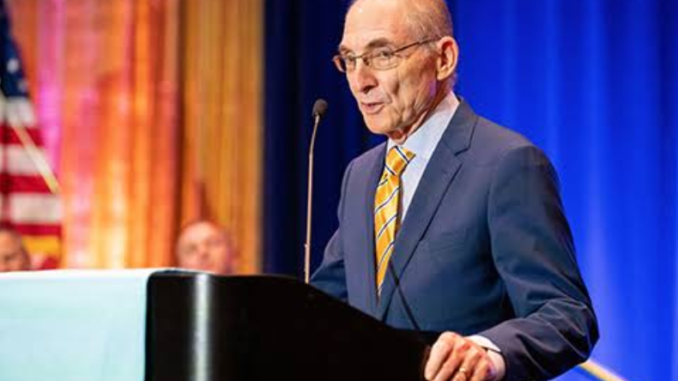
Eli Capilouto Unveils Bold Vision for the Wildcats’ New Era, Inspiring Players and Fans
Anticipation filled the air across the campus of Riverton University as students, alumni, faculty, and supporters gathered inside the Wildcats Arena for what had been announced only as a “special community address.” Rumors had circulated for days about significant changes within the athletics department, but no one expected the inspiring message that would unfold.
As the arena lights dimmed, a highlight video celebrating decades of Wildcats basketball played on the giant screens. It featured unforgettable victories, championship celebrations, community outreach programs, and countless moments that had united generations of fans.
When the video ended, University President Dr. Eleanor Brooks walked confidently to center court. The audience rose in applause.
She thanked the students, alumni, coaches, and supporters for their dedication before speaking about a changing era in college athletics.
“Every generation inherits a responsibility,” she said in this fictional story. “Our responsibility is not only to win games but to build a culture that prepares young people for success in every part of life.”
The statement drew another standing ovation.
Dr. Brooks explained that the university was launching a comprehensive initiative called The New Era Project, designed to strengthen player development, academic achievement, leadership training, community service, and fan engagement.
“Our athletes represent more than a basketball program,” she continued in this fictional account. “They represent families, classrooms, neighborhoods, and dreams.”
The announcement energized the crowd.
Players sitting courtside exchanged smiles as coaches applauded the vision.
The fictional athletic director then outlined several new initiatives that would welcome incoming student-athletes and help them adjust to campus life.
Each newcomer would be paired with an upperclassman mentor.
Leadership workshops would become part of preseason preparation.
Academic advisors would meet weekly with every athlete.
Mental wellness resources would be expanded.
Community volunteer projects would become a central part of the team’s identity.
“Our goal,” the athletic director explained in this fictional story, “is to ensure every player feels supported from the moment they arrive.”
The audience responded enthusiastically.
Several incoming freshmen later admitted they had been nervous about beginning their college careers.
One fictional recruit said the announcement immediately eased those concerns.
“When you hear university leaders talking about helping you grow as a person, not just as a player, it gives you confidence,” he said.
Returning players shared similar thoughts.
Team captain Marcus Hale addressed the crowd after the president finished speaking.
“When new teammates arrive,” Hale said in this fictional narrative, “they become part of our family on day one.”
His remarks received one of the loudest cheers of the afternoon.
Head coach Daniel Carter followed with an emotional speech about responsibility.
“A championship culture starts with trust,” he said. “Every player deserves encouragement, accountability, and an opportunity to improve.”
He emphasized that talent alone would never define the Wildcats.
Character, discipline, and teamwork would remain the program’s foundation.
Following the formal presentation, fans were invited onto the court for a community celebration.
Children participated in shooting contests.
Former players signed basketballs and jerseys.
Band members performed school songs while cheerleaders entertained the crowd.
The event quickly transformed into a campus-wide celebration.
Parents of incoming students expressed appreciation for the university’s emphasis on education and personal development.
One mother remarked that hearing the president speak reassured her family that her son would be joining a supportive environment.
Local business owners also welcomed the initiative.
Several pledged internships and career-development opportunities for student-athletes after graduation.
Faculty members announced expanded tutoring programs to ensure players balanced athletics with academic success.
Throughout the afternoon, the phrase “One Team, One Community” appeared on banners throughout the arena.
It soon became the unofficial slogan of the fictional initiative.
Students embraced the message, posting photographs with teammates, coaches, and alumni.
By evening, the entire campus seemed energized.
At a private team meeting later that night, Coach Carter reminded his players that speeches alone would not define the season.
“What matters,” he said, “is what we do tomorrow morning when practice begins.”
The players nodded.
They understood the expectations.
Early the next morning, workouts began before sunrise.
Veterans encouraged freshmen during conditioning drills.
Coaches praised effort as much as execution.
Mistakes became opportunities to learn rather than reasons for criticism.
The atmosphere reflected the values introduced the previous day.
During lunch, players from different class years sat together discussing goals for the season.
Some dreamed of conference championships.
Others hoped to earn academic honors.
Several simply wanted to become better teammates.
The sense of unity continued growing.
Over the following weeks, community service projects brought the Wildcats closer to local schools and charities.
Players visited children’s hospitals.
They read books at elementary schools.
They helped renovate neighborhood basketball courts.
The initiatives strengthened the bond between the university and the surrounding community.
As preseason practices intensified, reporters noticed a difference in the team’s energy.
Competition remained fierce, but encouragement replaced frustration.
Veterans celebrated freshmen making difficult plays.
Freshmen applauded experienced teammates for setting the standard.
Coach Carter smiled as he watched the culture develop.
“This,” he said in this fictional story, “is what lasting success looks like.”
The president attended several practices but rarely addressed the team directly.
Instead, she greeted players individually, asking about classes, families, and future career goals.
Her presence reminded everyone that the university valued students beyond athletics.
When the season opener finally arrived, Wildcats Arena reached capacity hours before tip-off.
Fans held blue-and-silver rally towels while the student section unveiled a giant banner reading:
“Building Champions On and Off the Court.”
The crowd erupted as players ran onto the floor.
Although the game itself was closely contested, supporters noticed something even more meaningful.
Every timeout featured teammates encouraging one another.
Bench players celebrated every successful play.
Coaches remained composed during adversity.
The culture described in the president’s speech had become visible.
After the final buzzer, regardless of the fictional outcome, players gathered at center court to thank the fans.
Coach Carter looked toward the stands before speaking quietly.
“This is only the beginning.”
His words captured the spirit of the fictional New Era Project.
The university had not promised perfection.
It had promised purpose.
And for everyone connected with Riverton University from incoming freshmen to lifelong supporters that purpose created optimism for the future.
As fans left the arena beneath the evening lights, conversations centered not only on basketball but also on leadership, education, community, and hope.
In this fictional world, the Wildcats had begun a new chapter defined not merely by victories, but by the belief that the strongest teams are built through character, compassion, and a shared commitment to something greater than the scoreboard.
Leave a Reply